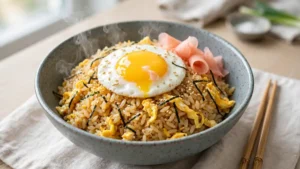
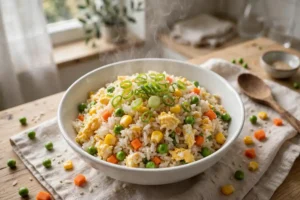
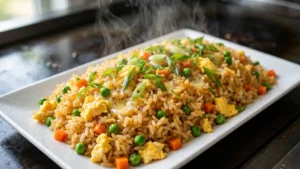
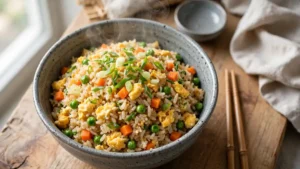
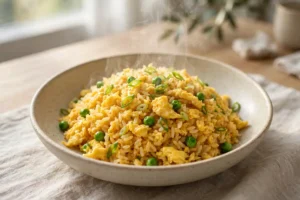
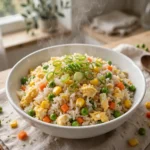
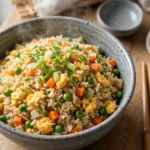
The most common Indo Chinese fried rice failure is limp vegetables and flat, one-note heat. Both come from the same mistake: a lukewarm pan and sauce poured over cold rice. This Indo Chinese fried rice recipe fixes both. The wok stays smoking hot, the vegetables fry in seconds so they stay crunchy, and the sauce hits the hot wok so it caramelizes instead of soaking in. It takes about 30 minutes and pairs well with Manchurian or chili chicken.
Indo Chinese fried rice is not regular Chinese fried rice. It uses more heat, more garlic, and a punchier sauce built on soy sauce, vinegar, and green chili sauce.

Menu of Indo Chinese Fried Rice Recipe
This Indo Chinese fried rice recipe covers why it works, the full ingredient list with US measurements, a troubleshooting table before the steps, step-by-step instructions, chef tips, substitutions, variations, storage and reheating guidance, and answers to common questions.
Why You’ll Love This Indo Chinese Fried Rice Recipe
- It tastes like the restaurant version. High heat, ginger-garlic, and a balanced soy-chili-vinegar sauce give that signature Indo-Chinese punch.
- It is ready in 30 minutes. Faster than ordering delivery, and cheaper too.
- It is endlessly flexible. Add egg, paneer, or chicken for protein, or keep it vegetarian.
Ingredients for Indo Chinese Fried Rice Recipe

For the Fried Rice
- 3 cups cooked long-grain white rice, chilled (day-old is best)
- 1 cup finely chopped cabbage
- 1/2 cup diced carrots
- 1/2 cup chopped French beans or green beans
- 1/2 cup frozen peas, thawed
- 4 spring onions (scallions), white and green parts separated and chopped
- 1 tablespoon ginger-garlic paste, or 2 cloves garlic plus 1/2 inch ginger, minced
- 2 to 3 green chilies, slit or finely chopped
- 3 tablespoons vegetable oil, divided
For the Sauce
- 2 tablespoons soy sauce
- 1 tablespoon white vinegar
- 1 to 2 teaspoons green chili sauce, or 1 teaspoon red chili sauce
- 1/2 teaspoon white pepper
- 1/2 teaspoon sugar
- Salt to taste
Notes on ingredients: Use long-grain white rice or basmati. Long grains stay separate and slightly springy when fried; avoid short-grain or sticky rice. Fresh ginger-garlic paste gives a stronger aroma than jarred, but jarred works for a quick weeknight. Cut the vegetables small and even so they cook fast and stay crunchy. White vinegar is the non-negotiable tang that separates Indo-Chinese from other fried rice styles. Adjust the chili sauce to your heat tolerance.
You will need: a large wok or 12-inch heavy skillet, a wooden spoon or wok spatula, measuring cups and spoons, and a small bowl for the sauce.
Common Mistakes and How to Fix Them
| Common Problem | Why It Happens | How to Fix It |
|---|---|---|
| Rice is soggy | Fresh rice used, or too much sauce | Use day-old chilled rice and measure the sauce; toss 1 minute longer over high heat |
| Vegetables are soft and limp | Heat too low, or wok overcrowded | Use high heat and cook in a single layer; fry vegetables before the rice |
| Dish tastes flat | Not enough vinegar or chili sauce | Add vinegar 1 teaspoon at a time and taste; bump up chili sauce for heat |
| Garlic tastes bitter | Garlic cooked too long before other ingredients | Add garlic with other aromatics and keep stirring; remove from heat if it darkens too fast |
| Rice sticks and breaks | Wok not hot enough, or cold oil | Heat the wok until smoking before adding oil; swirl oil to coat |
How to Make Indo Chinese Fried Rice Recipe
Step 1: Prep Everything
Chop the cabbage, carrots, beans, and spring onions. Slit the green chilies. Stir the sauce ingredients together in a small bowl. Break up the cold rice so no clumps remain. This Indo Chinese fried rice recipe cooks in under 10 minutes of active stir-frying, so have every ingredient beside the stove.
Step 2: Sear the Vegetables
Heat 2 tablespoons of oil in the wok over high heat until it shimmers and just begins to smoke. Add the carrots and beans first and stir-fry 1 to 2 minutes until they pick up golden spots but stay crunchy. Add the cabbage and peas, stir-fry 1 minute more, then move everything to a plate. The vegetables should be bright and crisp, not soft.

Step 3: Bloom the Aromatics
Add the remaining tablespoon of oil to the same wok over high heat. Add the ginger-garlic paste, green chilies, and the white parts of the spring onions. Stir-fry 30 to 45 seconds until deeply fragrant and the garlic turns golden at the edges. Do not let the garlic burn, or it will taste bitter.
Step 4: Fry the Rice
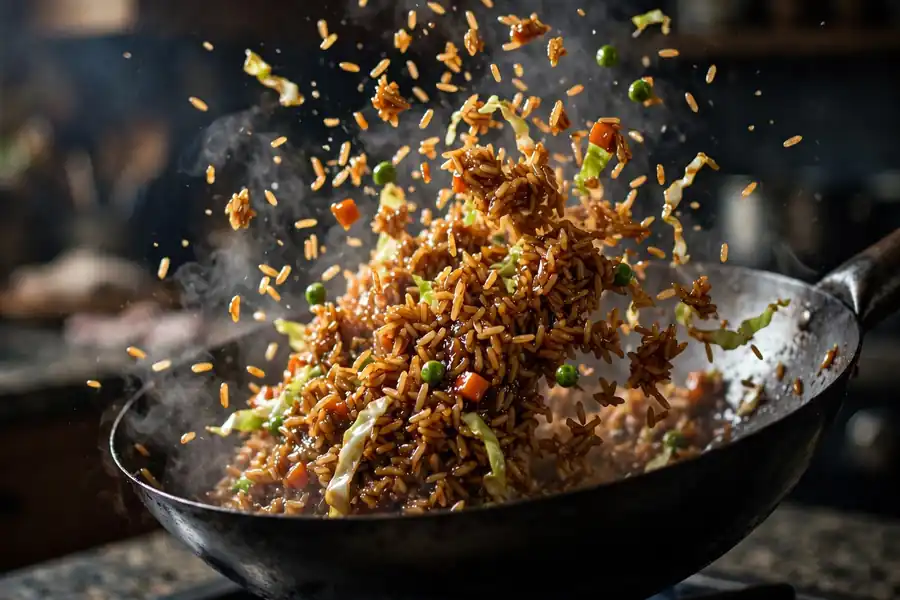
Add the cold rice to the wok. Break up any remaining clumps with the spatula and stir-fry 3 to 4 minutes, tossing constantly, until the grains are hot and starting to toast. A little smokiness at this stage is exactly what you want.
Step 5: Sauce and Combine
Pour the sauce around the hot edge of the wok rather than over the rice, so it sizzles and caramelizes for a few seconds before you toss it through. Toss 1 to 2 minutes until every grain is coated and glossy. Return the vegetables to the wok and toss 1 minute more. Taste and adjust: more soy sauce for salt, more vinegar for tang, more chili sauce for heat. Serve hot, topped with the green parts of the spring onions.

Chef’s Tips for the Best Results
- Cut vegetables small and even. They cook in seconds over high heat, and small pieces stay crunchy instead of turning raw in the middle.
- Let the wok smoke before you start. If your pan is only warm, the vegetables will steam instead of char.
- Balance the sauce before tasting rice. Mix the sauce and taste it with a spoon first. It should taste strong, salty, tangy, and a little spicy, because it gets diluted across 3 cups of rice.
Ingredient Substitutions
| Original Ingredient | Substitute | Expected Difference |
|---|---|---|
| Long-grain white rice | Basmati rice | Slightly more fragrant and a touch longer grain; equally good |
| Green chili sauce | Sriracha or red chili sauce | Red chili sauce is sweeter; use a little less sugar |
| White vinegar | Rice vinegar or lemon juice | Rice vinegar is milder; add a touch more for the same tang |
| White pepper | Black pepper | Stronger, more pine-like flavor; use half the amount |
| Ginger-garlic paste | 2 cloves minced garlic plus 1/2 inch grated ginger | Fresher and more aromatic; nearly identical results |
Recipe Variations
- Egg fried rice style: Scramble 3 beaten eggs first, set aside, and fold back in at the end.
- Chicken version: Add 1/2 pound thinly sliced chicken with the aromatics, cook 4 to 5 minutes until done, then proceed.
- Schezwan style: Stir 1 tablespoon of Schezwan chutney into the sauce for deeper chili-garlic flavor.
- Paneer version: Pan-sear 1 cup cubed paneer separately until golden and fold in at the end.
- Hakka noodles hybrid: Replace half the rice with cooked noodles for a fun street-cart mashup.
- Bell pepper crunch: Add 1/2 cup diced bell pepper with the cabbage for extra color and crunch.
Storage and Food Safety
Cool leftovers within 2 hours of cooking. Spread the rice on a wide plate to cool quickly, then transfer to airtight containers. Refrigerate up to 4 days. Freeze in portioned freezer bags up to 2 months, pressing out the air, and thaw overnight in the refrigerator. Discard rice that smells sour or sat out longer than 2 hours.
Meal-prep note: cook the rice a day ahead and chill it uncovered for the first 30 minutes, then covered. Chop the vegetables up to 2 days ahead and store in sealed containers. Mix the sauce and keep it in a jar in the refrigerator up to 1 week. Prep the ginger-garlic paste in bulk and freeze in ice cube trays.
How to Reheat Indo Chinese Fried Rice Recipe
The best way to reheat this Indo Chinese fried rice recipe is in a hot skillet. Heat a teaspoon of oil over medium-high heat, add the cold rice, and stir-fry 3 to 4 minutes, splashing in a teaspoon of water if it looks dry.
The microwave works too. Sprinkle a tablespoon of water over the rice, cover loosely, and heat 2 minutes, stirring halfway. Reheat leftovers with egg, chicken, or paneer to 165 degrees F (74 degrees C) throughout.
More Rice Recipes to Try
If you enjoyed this recipe, you will love these other rice dishes from The World of Rice:
- Authentic Chinese Shrimp Fried Rice Recipe: Traditional Technique, Pure Flavor
- Best Chinese Fried Rice Recipe: Restaurant-Style Flavor at Home
- Best Chinese Shrimp Fried Rice Recipe: Restaurant-Quality Secrets
- Chinese Beef Fried Rice Recipe: Takeout-Style & Better at Home
Frequently Asked Questions
What is the difference between Indo Chinese fried rice and regular fried rice?
Indo Chinese fried rice uses higher heat, more garlic and ginger, and a bolder sauce of soy sauce, vinegar, and chili sauce. It is smokier, tangier, and spicier than standard Chinese fried rice.
Can I use basmati rice for Indo Chinese fried rice?
Yes. Basmati works well because its long grains stay separate when fried. Cook it a day ahead and chill it for the best texture.
How do I get the smoky restaurant flavor at home?
Use a very hot wok, cook in small batches, and let the rice sit undisturbed for 30 seconds at a time so it chars slightly. A gas stove gives the best results.
Can I use freshly cooked rice?
It is not ideal, but you can. Cook it until just done, spread it on a sheet pan, and refrigerate uncovered until cold and firm before frying, so the grains do not clump.
Can I prepare this recipe ahead of time?
Yes. Cook the rice a day ahead, chop the vegetables up to 2 days ahead, and mix the sauce up to a week ahead. The actual stir-frying takes under 10 minutes.
How should I store leftovers?
Cool within 2 hours, refrigerate in airtight containers up to 4 days, or freeze up to 2 months. Thaw frozen rice overnight in the refrigerator.
Final Thoughts
This Indo Chinese fried rice recipe is all about heat, balance, and timing. Keep the wok smoking hot, use cold rice, season the sauce boldly, and keep the vegetables crunchy.
See the dictionary definitions for wok and soy sauce.

Prayvista Team is the editorial team behind Prayvista, The World of Rice. The team writes and reviews rice recipes for home cooks, and every article is checked by editor Sara Raza before publishing.