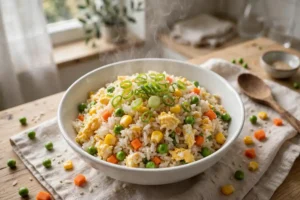
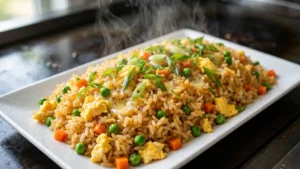
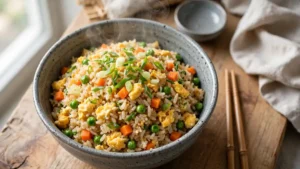
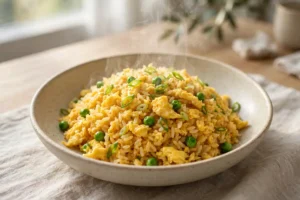
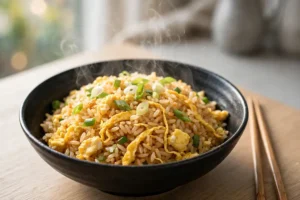
At a Japanese steakhouse, the egg in hibachi fried rice is never an afterthought. Cooks pour beaten egg directly onto the hot griddle, swirl it into a thin golden sheet, chop it into ribbons, and fold it through the rice so every bite has silky, buttery egg. This hibachi egg fried rice recipe teaches that exact griddle technique for home, even without a flat top. What sets it apart is the two-part egg method. Half the egg becomes thin ribbons, and the other half scrambles softly into the rice.
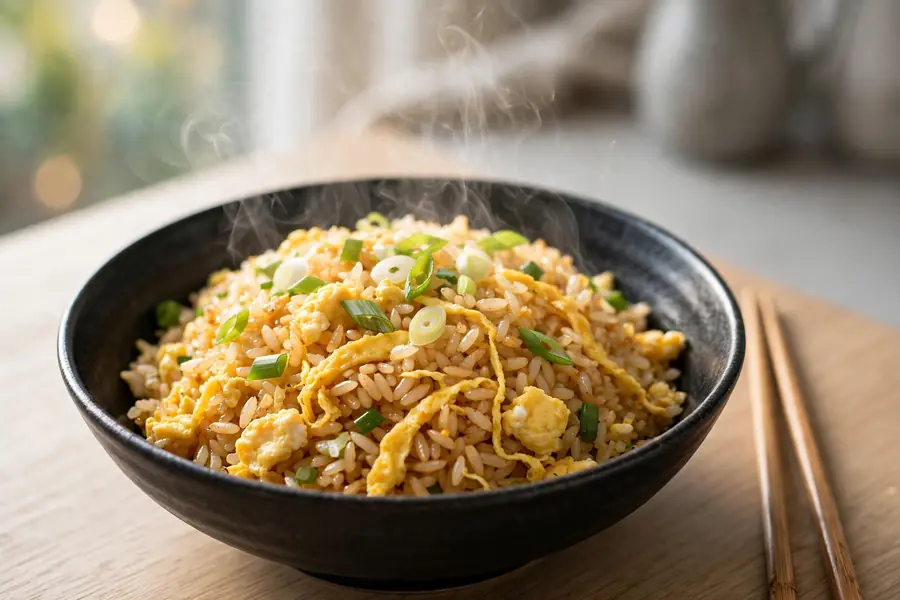
Menu of Hibachi Egg Fried Rice Recipe
This hibachi egg fried rice recipe covers the full ingredient list with US measurements, step-by-step instructions, why the egg method works, chef tips, a troubleshooting table, substitutions, variations, storage and reheating guidance, and answers to common questions.
Ingredients for Hibachi Egg Fried Rice Recipe
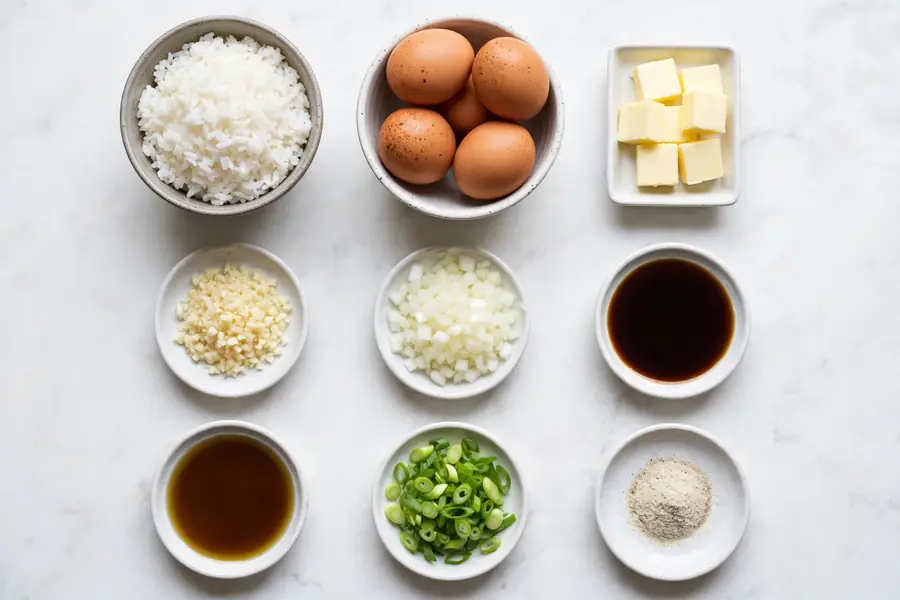
- 4 cups cooked white rice, chilled (day-old is best)
- 4 large eggs, divided
- 3 tablespoons unsalted butter, divided
- 1 tablespoon vegetable oil
- 3 cloves garlic, minced
- 1/2 cup diced yellow onion
- 3 tablespoons soy sauce
- 1 teaspoon toasted sesame oil
- 1/2 teaspoon white pepper
- 1/4 teaspoon salt
- 3 scallions, thinly sliced
Notes: Four eggs might sound like a lot, but two go into the ribbon sheet and two scramble into the rice. Beating them in one bowl and splitting the mixture keeps the prep simple. Use room-temperature eggs if you can; they spread more evenly on the hot surface. Day-old rice is non-negotiable here because the egg adds moisture. Fresh rice plus egg equals mush, so chill the rice uncovered for at least a few hours so the surface dries out. If you forgot, spread it in a thin layer and freeze for 15 to 20 minutes. Use a neutral oil with a high smoke point, like vegetable or avocado oil, for the hot surface, and save the butter for flavor. Butter alone can burn on a very hot griddle before the rice finishes.
You will need: a large griddle or your largest skillet, two flat metal spatulas, a small bowl for the beaten eggs, and a fork for breaking up the cold rice.
How to Make Hibachi Egg Fried Rice Recipe
Step 1: Prep the Rice and Eggs
Break up the chilled rice into individual grains with a fork. Beat all 4 eggs in a bowl until completely smooth, then pour half into a second small bowl. This hibachi egg fried rice recipe uses the two halves differently, so keep them separate. Mince the garlic and dice the onion.
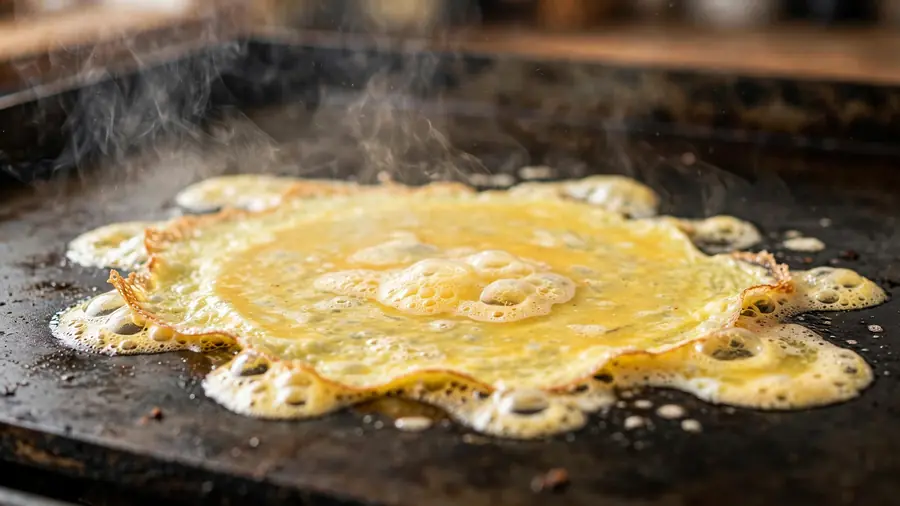
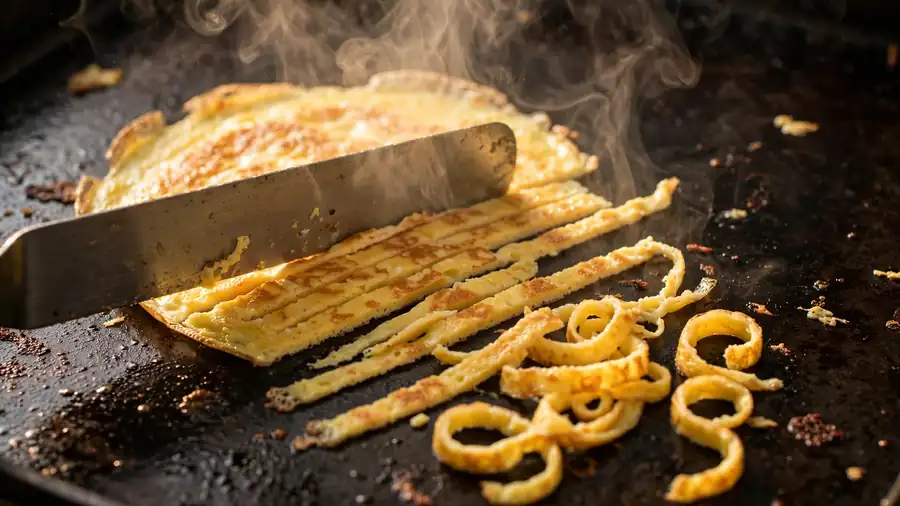
Step 2: Cook the Egg Ribbons
Heat 1 tablespoon of butter on one side of a very hot griddle or skillet until it foams. Pour in half the beaten egg and immediately tilt or use a spatula to spread it into the thinnest sheet possible. It sets in about 20 to 30 seconds. Flip once, cook 10 more seconds, then chop into thin ribbons right on the griddle. Move to a plate.
Step 3: Sizzle the Garlic and Onion
Add the vegetable oil to the griddle over high heat. Add the onion and cook 2 minutes until softened at the edges. Add the garlic and cook 30 seconds until fragrant and just golden. Do not let the garlic darken past gold or it turns bitter.
Step 4: Fry the Rice
Add the rice to the hot surface and break up any remaining clumps. Spread into a thin layer, rest 1 minute, then toss and chop. Repeat for 3 to 4 minutes until the grains are hot and lightly golden in spots. The rice should look dry and separate, not wet. If your pan is crowded, fry in two batches; a deep pile steams instead of frying.
Step 5: Scramble the Remaining Egg
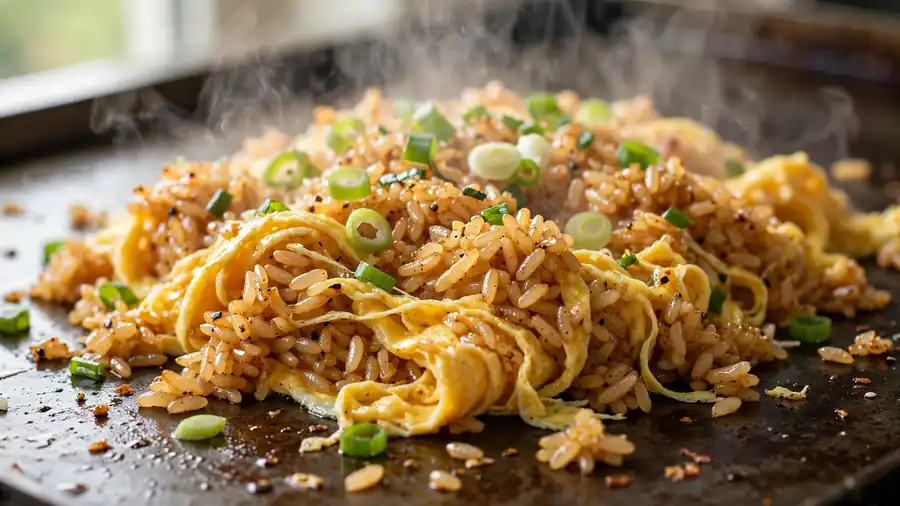
Push the rice to one side. Add the remaining tablespoon of butter to the cleared hot surface and pour in the rest of the beaten egg. Scramble 20 to 30 seconds into soft curds, then fold into the rice.
Step 6: Season and Finish
Pour the soy sauce onto the hot surface beside the rice, let it sizzle 10 seconds, then toss everything through it. Add the sesame oil, white pepper, and salt, and toss 1 minute. Fold in the egg ribbons and the scallions, toss 30 seconds, and serve immediately.
Why This Works
- Two egg textures beat one. Thin ribbons add a delicate, silky texture, while the soft scramble gives richness throughout.
- A very hot surface protects the rice. High heat drives off the egg’s moisture almost immediately, so day-old rice stays dry and separate.
- Garlic goes in late and briefly. Thirty seconds after the onion is enough for fragrance without bitterness.
- Soy sauce sizzles on bare metal first. Ten seconds on the hot surface deepens the flavor before it coats the rice.
Chef’s Tips for the Best Results
- Spread the egg as thin as you can. A thin sheet sets fast and stays silky. A thick pour becomes a rubbery omelet.
- Chop the ribbons on the griddle. The residual heat keeps them pliable, and chopping right on the surface is how the steakhouses do it.
- Keep the two egg halves straight. The ribbon half needs the hottest surface; the scramble half goes in after the rice.
- Work fast once the heat is on. Have the rice broken up and the eggs split before the griddle gets hot.
Common Mistakes and How to Fix Them
| Common Problem | Why It Happens | How to Fix It |
|---|---|---|
| Egg sheet is thick and rubbery | Too much egg poured at once, or the surface was not hot enough | Use only half the egg and spread it thin on a fully heated surface |
| Rice turns mushy | Egg moisture plus fresh rice | Use day-old chilled rice, and keep the heat high |
| Garlic tastes bitter | Garlic cooked too long on high heat | Add garlic after the onion and limit it to 30 seconds |
| Egg ribbons break into crumbs | Chopped after cooling, or sheet was too thick | Chop while still hot and pliable, on the griddle |
| Bland flavor | Not enough soy sauce, or no sesame oil finish | Taste before serving and adjust; the sesame oil adds aroma |
Ingredient Substitutions
| Original Ingredient | Substitute | Expected Difference |
|---|---|---|
| Butter | Ghee | Similar richness with a higher smoke point; slightly nuttier |
| White pepper | Black pepper | A sharper, more noticeable heat |
| Yellow onion | Sweet onion or shallots | Sweeter and milder; shallots are more delicate |
| Vegetable oil | Avocado oil | Higher smoke point; no flavor change |
| Scallions | Chives | Milder onion flavor; add at the same step |
Recipe Variations
Cheese melt: Sprinkle 1/2 cup of shredded mozzarella over the rice in the last minute and cover briefly to melt.
Garlic overload: Double the garlic and add it in two additions, half with the onion and half tossed in raw at the end.
Spicy: Add 1 teaspoon of chili garlic sauce with the soy sauce.
Protein boost: Add 1 cup of diced cooked chicken or shrimp with the rice in Step 4.
Store, Reheat, and Prep Ahead
Cool within 2 hours and refrigerate in airtight containers up to 4 days. Freeze up to 2 months. Because this dish is egg-heavy, cool it quickly and reheat it thoroughly until steaming. Discard leftovers that sat at room temperature longer than 2 hours or smell off.
To reheat, stir-fry in a skillet over medium-high heat with a teaspoon of oil for 3 to 4 minutes until steaming hot throughout. Or microwave: sprinkle a tablespoon of water over the rice, cover loosely, and heat 2 minutes, stirring halfway.
For prep ahead, cook and chill the rice up to 3 days ahead. Beat the eggs the morning of cooking and refrigerate. Slice the scallions up to 3 days ahead. The egg ribbon step takes only a minute, so cook it fresh.
More Rice Recipes to Try
If you enjoyed this recipe, you will love these other rice dishes from The World of Rice:
- Authentic Egg Fried Rice Recipe: Simple, Silky & Perfectly Golden
- Authentic Fried Rice Recipe With Egg: The Traditional Golden Method
- Bacon And Egg Fried Rice Recipe: Smoky, Savory & Ready in 25 Minutes
- Best Hibachi Fried Rice Recipe: Japanese Steakhouse Copycat
Frequently Asked Questions
Why cook the egg in two different ways?
The thin ribbons add a delicate, silky texture, while the soft scramble gives richness throughout. Two textures make the dish more interesting than one.
Can I make the egg ribbons without a griddle?
Yes. Use your largest skillet over high heat and work in half the egg at a time so it spreads thin.
How thin should the egg sheet be?
As thin as a crepe, ideally. It should set in under 30 seconds. If it takes longer, the surface was not hot enough.
Can I use egg whites only?
You can, but the ribbons will be paler and less rich. Use 6 egg whites to replace 3 whole eggs for the ribbon portion.
Will the egg make the rice soggy?
Not if the rice is day-old and the pan is very hot. The high heat drives off the egg’s moisture almost immediately.
Final Thoughts
This hibachi egg fried rice recipe shows that egg is not a filler. Cooked two ways on a hot griddle, it becomes the reason the dish works. Try the ribbon technique once and you will use it every time.
See the dictionary definitions for white rice and butter.

Prayvista Team is the editorial team behind Prayvista, The World of Rice. The team writes and reviews rice recipes for home cooks, and every article is checked by editor Sara Raza before publishing.